Traditional discovery is brilliant but slow. It takes years of trial, error, refinement, and countless experiments to answer questions like:
- Which biological target will make a difference?
- What molecule stands a real chance of binding to it?
- How do we predict toxicity before it becomes a problem?
Earlier, researchers could only explore a tiny fraction of chemical space.
AI changed that forever. Suddenly, machines can scan millions of compounds, reason through decades of scientific papers, and identify patterns invisible to human eyes. What was once an ocean of uncertainty has become a landscape of possibilities. And you are stepping into this field at the perfect moment—right when the science is exploding with new opportunities.
What AI Actually Does in Discovery
Think of AI as an endlessly patient, hyper-curious research partner. It does not get tired, overwhelmed, or biased by its own memory. It simply keeps learning.
Here’s how it transforms the journey from idea to molecule.
- AI Reads Science Like a Researcher With Infinite Stamina
Imagine asking a junior scientist to review every paper ever written on your therapeutic area. Impossible for a human. Effortless for AI.
It devours:
- journal articles
- patents
- structural databases
- clinical outcomes
- real-world evidence
- internal reports
And then it connects the dots. AI doesn’t just look at words—it reconstructs mechanisms, understands pathways, identifies biomarkers, and detects subtle hints buried beneath years of literature. It reads with scientific intent.
- AI Predicts Which Molecules Actually Stand a Chance
When medicinal chemists sketch a structure, they are making an intellectual guess.
AI evaluates that guess mathematically.
It predicts:
- binding affinity
- solubility
- permeability
- toxicity
- metabolic liabilities
- synthesis complexity
Within seconds. Suddenly, instead of testing 10,000 molecules, teams test 200 that matter. Speed does not compromise science—speed accelerates it.
- AI Designs New Molecules That Never Existed Before
This is where discovery becomes magical.
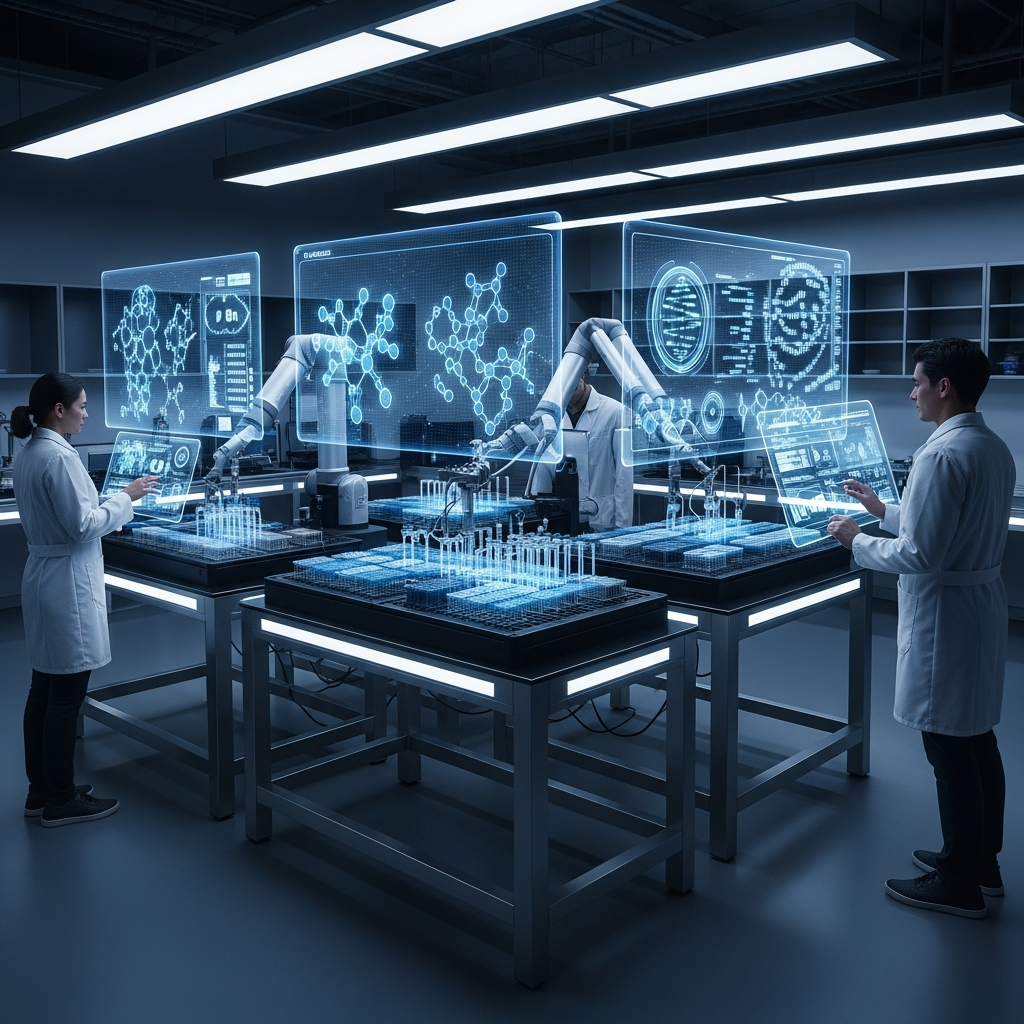
Generative AI models can create novel structures atom by atom, guided by biological goals:
“Design a molecule that fits this binding pocket, avoids cardiotoxicity, and is synthetically accessible.”
AI then proposes options no human chemist has imagined—structures that reflect the chemistry of possibility, not the limits of memory.
This moment—watching the model generate a new molecular idea—is where many young scientists realize the future has arrived.
- AI Connects Discovery to Everything That Follows
Drug discovery is not an isolated stage.
Every decision influence safety, formulation, clinical response, and regulatory strategy.
AI bridges these worlds.
It predicts:
- early safety risks
- manufacturability concerns
- clinical trial feasibility
- regulatory alignment issues
long before a molecule touches a lab bench. AI makes discovery smarter, not just faster.
Why This Is the Best Time to Start Your Career
As a graduate stepping into pharma, AI may feel complex or intimidating.
But here’s the truth:
You are the generation that will master this effortlessly.
You already live in a world shaped by algorithms. Transitioning that intuition into scientific AI is not a leap—it’s a natural evolution. And companies everywhere are searching for professionals who can blend scientific understanding with AI reasoning.
You don’t need to be a coding expert. You just need curiosity, commitment, and the courage to learn tools that expand your impact.
Message to You
Take this moment seriously. You are not learning AI for the sake of technology.
You are learning a new language—the language of modern drug discovery.
A language that lets you:
- read the world’s scientific knowledge at once
- design molecules without boundaries
- detect safety issues early
- collaborate with intelligent systems
- shape the future of medicine
Few generations get to witness a shift this profound.
You are not just witnessing it—you are entering the field right when the door is opening.